
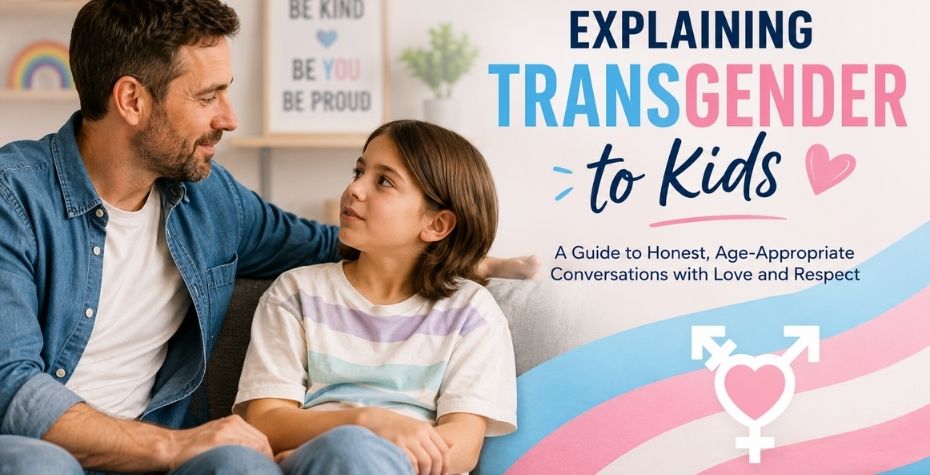
When a co-parent begins any new relationship, children will always often have questions as children do. What happens now though if say that new partner is transgender? Parents may wonder how to answer those questions in a way that is honest, age-appropriate, and supportive.
Every family is different, and there is no single “perfect” conversation, because that would just be too easy. However, experts have generally agree that children benefit most from truthful, simple explanations that match their developmental level. They also benefit when both parents avoid putting them in the middle of adult disagreements.
Start With Your Child’s Questions
Children often don’t need lengthy explanations. Many kids simply notice something different and ask a straightforward question. For younger children, a simple explanation may just be enough.
“ of, relating to, or being a person whose gender identity differs from the sex the person was identified as having at birth”
Older children and teenagers may ask more detailed questions about gender identity, pronouns, or transition. This is absolutely fine with how their development progresses. Just answer honestly. Using language, they can understand and let them know it’s okay to ask respectful questions.
Keep the Conversation Honest
Honesty builds trust between parents and children. Lying or hiding never produces anything positive.

If your child asks whether someone is transgender, avoid making up stories or encouraging them to ignore what they have observed. Just listen. If you know the answer and it is appropriate to share, provide a factual, respectful explanation without unnecessary detail.
Likewise, always avoid asking your child to keep secrets from the other parent. Children should never feel responsible for managing adult relationships or conflicts.
Separate Adult Conflict from Your Child’s Relationship
If you have concerns about your co-parent’s new relationship, try to distinguish those concerns from the person’s transgender identity.
Some questions worth considering include:
- Is the new relationship healthy?
- Is the adult treating the children respectfully?
- Are parenting plan provisions regarding new partners being followed?
- Are introductions occurring at an appropriate pace?
- Is the child’s emotional well-being being considered?
These concerns can exist regardless of whether the new partner is transgender or not.
Explain That Families Come in Many Forms
Children are naturally accepting when information is presented calmly.
You may say:
“Families look different for everyone. Some families have a mom and a dad. Some have two moms or two dads. Some parents date new people after they separate (with appropriate healing time between relationships). Some people may also be transgender. What’s most important is that people treat each other with kindness and respect.
This keeps the focus on the values rather than labels.
Pros of Honest, Age-Appropriate Conversations
Being open with children can have several benefits:
- Builds trust between the parent and child
- Reduces confusion and anxiety
- Encourages respectful behavior toward others
- Helps children feel comfortable asking questions
- Prevents misinformation from friends or social media
- Reinforces that honesty is valued within the family
Potential Challenges
These conversations can also present challenges:
- Parents may disagree on when or how to discuss the topic
- Children may receive conflicting information between households (which may include lies)
- Older children may encounter misinformation online
- Family members may hold different personal or religious beliefs
Recognizing these challenges allows parents to prepare thoughtful, respectful responses rather than reacting emotionally.
What If Parents Disagree?
Co-parenting after separation is rarely simple. Trust me, it can be very stressful and comes with all types of issues.
If parents disagree about how to discuss gender identity, consider focusing on shared goals:
- Keeping conversations age appropriate
- Answer questions honestly
- Avoid negative comments about the other household
- Support the child’s emotional health as this should always be priority
- Following any parenting plan regarding introductions of new partners
Even if parents hold different beliefs, children generally benefit from consistency, honesty, and respectful communication.
Some Mistakes to Avoid
Try to avoid:
- Speaking negatively about someone because they are transgender
- Asking children to keep secrets
- Giving information that is knowingly false
- Overloading young children with adult topics
- Using children to gather information about the other household
- Making children feel they must choose between parents
Helping Children Feel Safe
Children usually adapt well when they feel secure.
Remind them that:
- They are loved by both parents
- They can ask questions at any time
- It’s okay to feel confused or curious
- Adults are responsible for adult decisions
- They do not have to take sides
Final Thoughts

A co-parent’s new relationship usually brings change, and children often need more reassurance than detailed explanations. Honest, age-appropriate conversations help children understand the world around them while maintaining trust in the adults who care for them. Any form or lying about it doesn’t help.
Whether parents agree on every issue or not (which usually will never happen), focusing on truthfulness, respect, and your child’s emotional well-being provides the strongest foundation for healthy communication. Remember, as a single parent, your kids and their wellbeing should always come before your new relationship.
If disagreements become significant, a family therapist or parenting coordinator may be able to help both parents develop a consistent approach that supports the child’s best interests.